


2026 Mass Save Heat Pump Rebate Updates and Requirements | Rebates & Tax Credits | Milford, MA
The 2026 Mass Save® heat pump rebates in Milford have been updated with new rules and lower limits, including a $1,500 reduction from 2025 amounts. Homeowners should act quickly, as rebates now top out at $8,500 and require efficient systems using low-GWP refrigerants to qualify.
2026 Mass Save Heat Pump Rebate Updates and Requirements
As the cost of energy rises and Massachusetts continues its push to decarbonize, many homeowners in Milford, MA are turning their attention to heat pumps for year-round comfort and energy efficiency. Heat pumps are not only an environmentally responsible upgrade but one of the few home improvements that offer major financial incentives—specifically through the Mass Save® program.
However, the 2026 updates to the Mass Save® heat pump rebate structure come with critical changes: lower rebate amounts, stricter eligibility requirements, and new standards that could significantly impact your ability to qualify. If you're considering a heat pump upgrade in Milford, understanding these updates is more vital than ever.
"2026 brings timely opportunities for Milford homeowners, but only if they act early—rebates are shrinking and requirements are getting more rigorous with each year."
Let’s break down what’s changed, what you need to consider as a homeowner in Milford-MA, and why it’s becoming increasingly essential to move quickly.
Key Mass Save® Heat Pump Rebate Changes in 2026
Lower Rebate Amounts Than 2025
In contrast to previous years, the 2026 rebates have been scaled back. Homeowners in Milford and across Massachusetts can still tap into incentives—but they'll be receiving less than what was available in 2025.
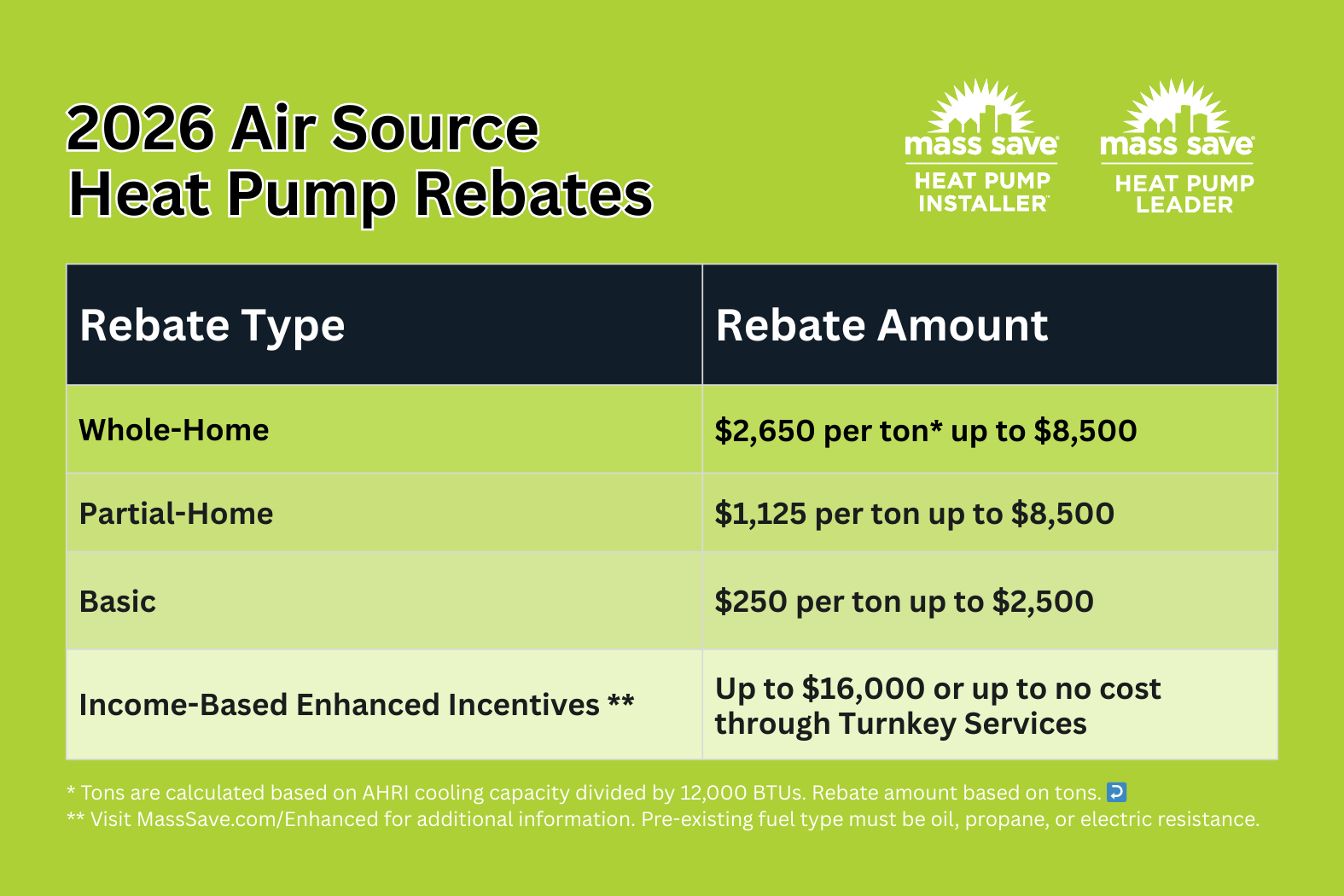
- Whole-Home Heat Pump Rebates: $2,650 per ton, capped at $8,500 (down from $10,000 in 2025)
- Partial-Home Heat Pump Rebates: $1,125 per ton, capped at $8,500
- Basic Heat Pump Rebates: $250 per ton, capped at $2,500
- Income-Based Heat Pump Rebates: Up to $16,000, or potentially no cost through Turnkey Services
These decrease by $1,500 from 2025 across the board, signaling that incentive levels are on a downslope year over year.
"The earlier you start your heat pump upgrade, the more you’ll save—waiting until next year could cost Milford homeowners thousands in lost rebates."
Phase-Out of Non-Compliant Refrigerants
Many legacy systems still rely on R-410A refrigerant, but these are now disqualified from receiving 2026 Mass Save® rebates. Current program criteria prioritize low-GWP (Global Warming Potential) refrigerants, reflecting a broader environmental policy shift across Massachusetts.
Only heat pumps with approved refrigerant types—like R-32 or R-454B—will meet rebate requirements in 2026.
No Federal Heat Pump Tax Credits for 2026
Another key change for Milford residents planning ahead: The federal tax credit for heat pumps has expired in 2026. That makes the Mass Save® program the primary financial incentive still available for offsetting up-front costs.
Heat Pump Benefits for Milford-MA Homeowners
Year-Round Efficiency in New England’s Tough Climate
Milford winters can bring snow and freezing temperatures, requiring reliable heating. But our muggy summers also demand effective cooling. This dual need makes heat pumps ideal for homeowners in the area. They offer:
- Consistent warmth during the region’s cold spells
- Efficient air conditioning during humid summer months
- Improved indoor air quality and zoned heating and cooling
Modern cold-climate heat pumps are designed to operate efficiently even in temperatures well below freezing, making them a dependable choice for Massachusetts homes.
Lower Energy Bills and Less Carbon Emissions
Switching to a qualifying heat pump setup offers not just comfort but steep energy savings. These systems use electricity rather than combustion to move heat, drastically reducing your home’s reliance on fossil fuels. That results in:
- Lower monthly utility bills
- Fewer carbon emissions contributing to climate change
- A smaller overall environmental footprint
"For Milford households looking to slash their heating oil or propane usage, heat pumps are one of the most cost-effective solutions."
Lighting, HVAC, and hot water together make up about 65% of Massachusetts households’ energy usage. Improving HVAC efficiency alone, especially in older homes common around Milford, can drastically reduce total energy demand.
Understanding the Rebate Types Available in 2026
Whole-Home Rebates for Full System Installations
Installing a whole-home heat pump system—one that entirely replaces existing fossil fuel systems—offers the highest rebate totals. As of 2026, that's $2,650 per ton of capacity, capped at $8,500.
- Requires full replacement of your existing HVAC system
- Must meet required system efficiency and low-GWP refrigerant regulations
- Ideal for homeowners ready to completely transition to electric heating and cooling
Whole-home installations are the most supported by the Mass Save® program because they provide the greatest environmental benefit.
Partial-Home and Basic Rebates for Supplementary Systems
Not ready for a full transition yet? You may still qualify for partial-home or basic rebates:
- Partial-Home: $1,125 per ton, capped at $8,500
- For homes supplementing existing systems with high-efficiency heat pumps
- Basic: $250 per ton, capped at $2,500
- Good for limited-zone usage, such as single-room installations
While these lower amounts don’t offer the same return as full-system upgrades, they allow homeowners to gradually move toward full electrification.
Income-Based Enhanced Rebates
Through Mass Save’s Turnkey Heat Pump Program, qualifying income-based households in Milford can receive:
- Rebates of up to $16,000
- Opportunities for heat pump installations at little to no cost
This program is a unique effort to ensure heat pump technology is accessible to all Massachusetts residents, regardless of income level.
You can learn more on the official Mass Save Air Source Heat Pump Rebate page.
New Technical Requirements Every Milford Homeowner Should Know
Qualified Refrigerant Types Now Needed
As mentioned earlier, the biggest technical update to the 2026 rebates is the refrigerant requirement. To qualify for a rebate:
- Your new system must use a Low-GWP refrigerant
- Older refrigerants like R-410A will disqualify you
- Manufacturer specs must match Mass Save efficiency and refrigerant standards
When shopping for systems or speaking with contractors, be sure your chosen heat pump uses either R-32 or R-454B to ensure compliance and maximize rebates.
Important System Configuration and Timing Factors
- All system components must be new—not refurbished or secondhand
- Equipment must be installed by a Massachusetts licensed contractor participating in the Mass Save program
- System design and calculation documents, such as load calculations, are typically expected to ensure the chosen system is appropriately sized
- The rebate application must be submitted shortly after installation; delays could jeopardize eligibility
Timing also matters. Historically, delays in rebate processing with Mass Save can occur, particularly toward the end of the year or during high-volume seasons. Early applications secure higher savings and better access.
Rebate Trends Suggest Moving Sooner Rather Than Later
Rebate Dollars Are Decreasing, Not Increasing
Unlike many government programs that increase benefits over time, Mass Save’s path for rebates has been contractionary. The $1,500 drop in available funds from 2025 to 2026 shows a clear trend: delayed action means less money in your pocket.
Milford Residents Can Still Access Utility Offsets
Local utility providers commonly offer seasonal “winter reduced rate” programs for off-peak heat pump usage. Depending on your utility company, you may qualify for additional savings through time-of-use or smart thermostat programs.
These are especially valuable in Milford, where colder months bring high electric demand. Pairing a heat pump with a time-of-use plan could mean amplified savings beyond the rebate.
Why Heat Pumps Remain the Best Electrification Upgrade in MA
Despite the lower rebates and increased restrictions in 2026, heat pumps remain the most financially and environmentally backed upgrade in Massachusetts.
Milford homeowners are in a perfect position to take advantage of this. The state's grid is becoming greener, electricity prices are stabilizing, and support infrastructure for electric heating is stronger now than it was just a few short years ago.
Choosing a certified Mass Save contractor and selecting compliant heat pump equipment ensures you’re preparing your home for the clean energy future, while still offsetting costs with available 2026 rebates.
What Milford Homeowners Should Do Now
Homeowners in Milford considering a heat pump upgrade in 2026 have a narrow window to lock in these remaining incentives. With changes to refrigerant requirements, declining rebate values, and expiring federal credits, the most successful projects in 2026 are those that begin planning immediately and work with knowledgeable providers.
Key steps to take now:
- Identify if your home system is eligible for full or partial replacement
- Verify that your preferred system uses low-GWP refrigerants
- Don’t delay—rebates are actively reducing each year
The Mass Save program continues to offer strong support—but it’s clear that the longer you wait, the more you'll lose in potential savings.
Learn more about Mass Save-approved air-source heat pumps and current eligibility at the official Mass Save website.

What Local Homeowners Are Saying
See how SumZero has helped local homeowners stay comfortable year-round with energy-efficient heat pump solutions.


Not Sure Where to Start? We’ll Guide You
Let our experts design the right heating and cooling solution—customized for your comfort, your layout, and your energy goals. No pressure. Just clarity.
